















When researchers talk about AI, speed tends to take over. What can we summarize faster? What can we synthesize faster? What can we make in an afternoon that used to take a week?
After speed, the conversation almost always turns to scale. How much bigger can we make our exploration? How much more data can we consume? Research is always bumping into limits—time, budget, access, geography, language—and AI seems like an easy way to unshackle ourselves from those constraints. But deployed without intention, it’s nothing more than a shiny research assistant.
We’re much more interested in what we can do and learn now that we couldn’t before. We want to use it to ask bigger questions, take in more context, and engage with complexity in entirely new ways. And using it intentionally requires us to figure out three things: Where in the design research process is AI most impactful? What is appropriate for AI to do versus humans? And what does that mean for the role of research in the design process?
We’ve been using a simple but generative 2x2 to help us explore the potential of AI to enrich our research practice and prototype what’s possible, meaningful, and responsible.

The framework takes AI’s basic affordances—speed and scale—and frames them as dials we can turn up and down, rather than a switch to turn on and off. Sometimes we want AI to accelerate learning. Other times, we need it to slow us down, add friction, and make our thinking more calculated. Sometimes AI meaningfully expands the scale of context we can take in. Other times we need it to help us interrogate a defined space more deeply. It’s the intersection of these dynamic affordances that gives us four useful modes for leveraging AI in design research, modes we can and should learn to move fluidly and thoughtfully through across the research and design process.

1. Widen our aperture
This first mode is what most people think about when they think about AI—doing more, faster. Here, we’re using AI to accelerate and expand a field of inquiry to take in more than a constrained project plan would normally allow.
Design teams might use AI to compile desk research, translate source material, ingest complex data sets, or clean up messy data formats. This is often where teams start, because the value is easy to see—a bigger workbench.
The dynamic survey is a good example of this mode in action. Imagine asking hundreds or thousands of people how they define the boundaries of their community. In a traditional open-ended survey, someone might answer, “my closest friends,” and the research team would have to interpret that nonspecific response later. In contrast, a dynamic survey can ask follow-up questions in the moment: “Are those friends geographically close? What makes someone be inside or outside of that circle? Why does that boundary matter?” The scale of the survey remains the same. The texture of data we’re able to capture, however, becomes richer and more qualitative. And AI helps us grapple with the complexity of that qualitative data at scale.
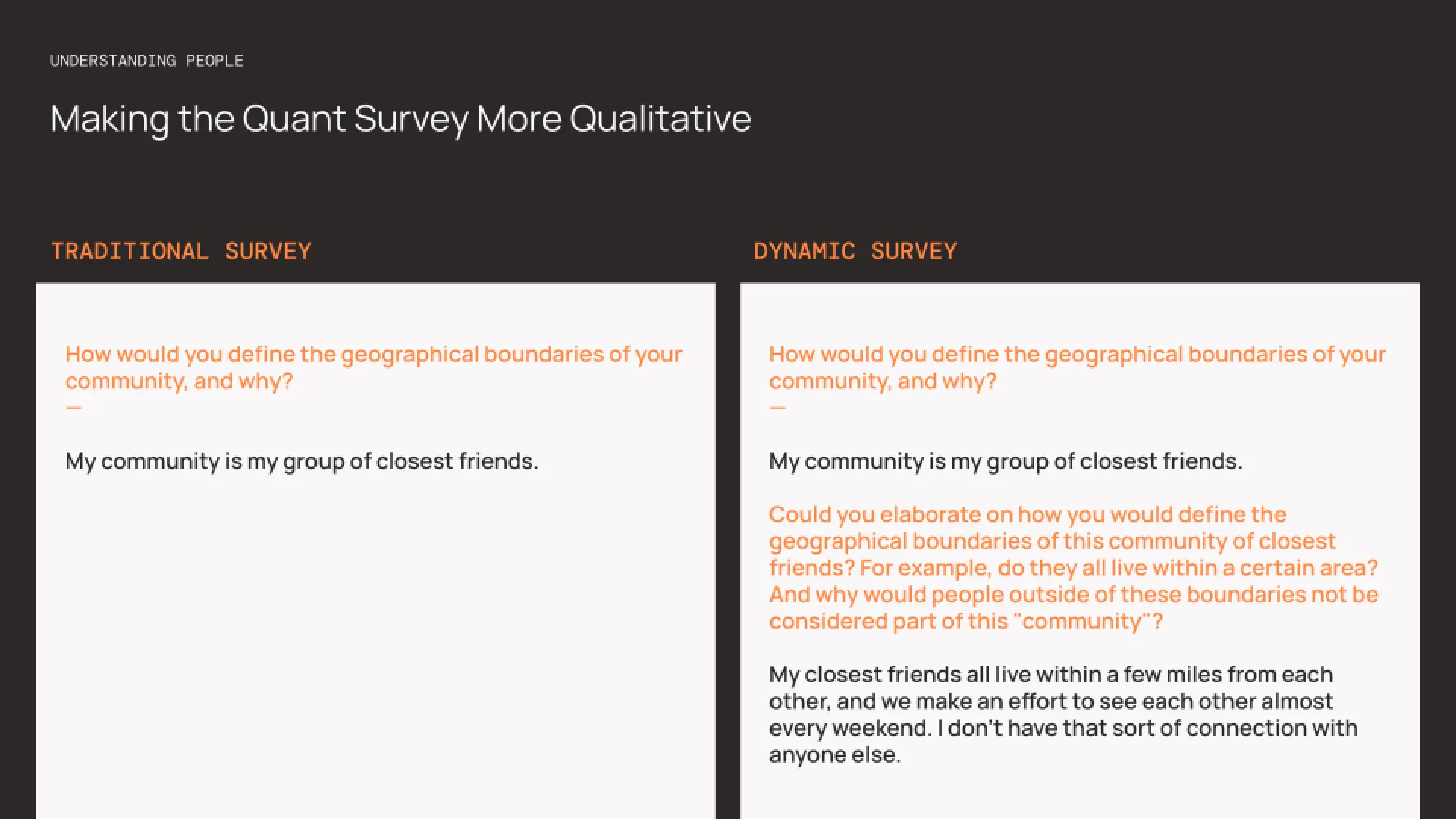
Widening our aperture does not mean exploring forever. More data and deeper understanding are not the same thing. Research is about meaning-making, and constraint is still part of the craft to get to understanding. The point is to be more intentional about where we narrow our focus, instead of letting operational limits decide which contexts, voices, or edge cases make it into the work.
2. Help us notice nuance
When we have a body of research in hand, we can shift into a different relationship with AI. Here, AI can help surface patterns, connections, and tensions. It might help identify missing perspectives before fieldwork begins, find analogs that sharpen a research plan, or generate an early structure that makes synthesis easier to start.
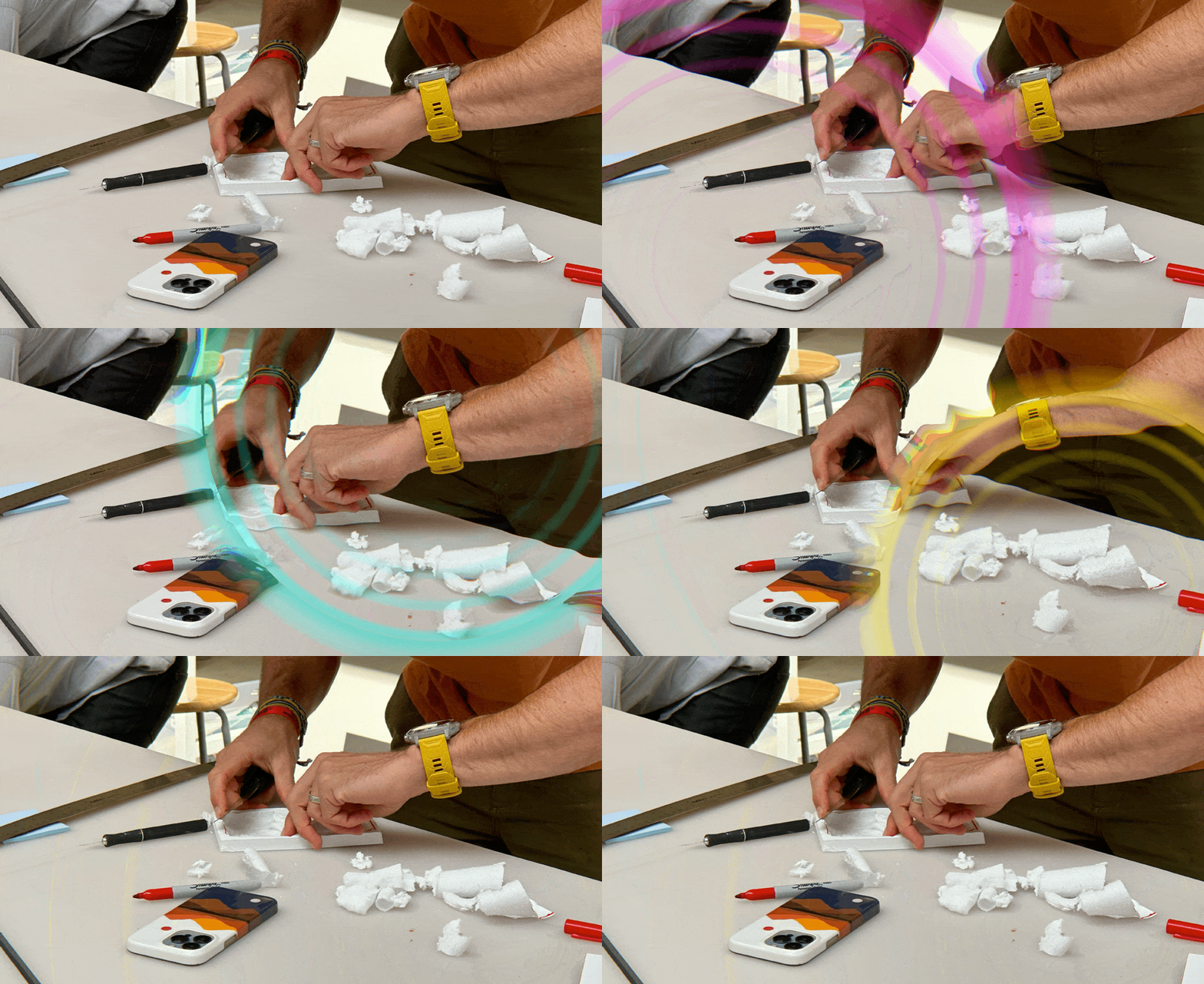
It can also make participant input easier to react to and build on. We can turn their sketches or half-formed descriptions into a prototype on the spot, giving their idea a weight and volume, and a role they can imagine.
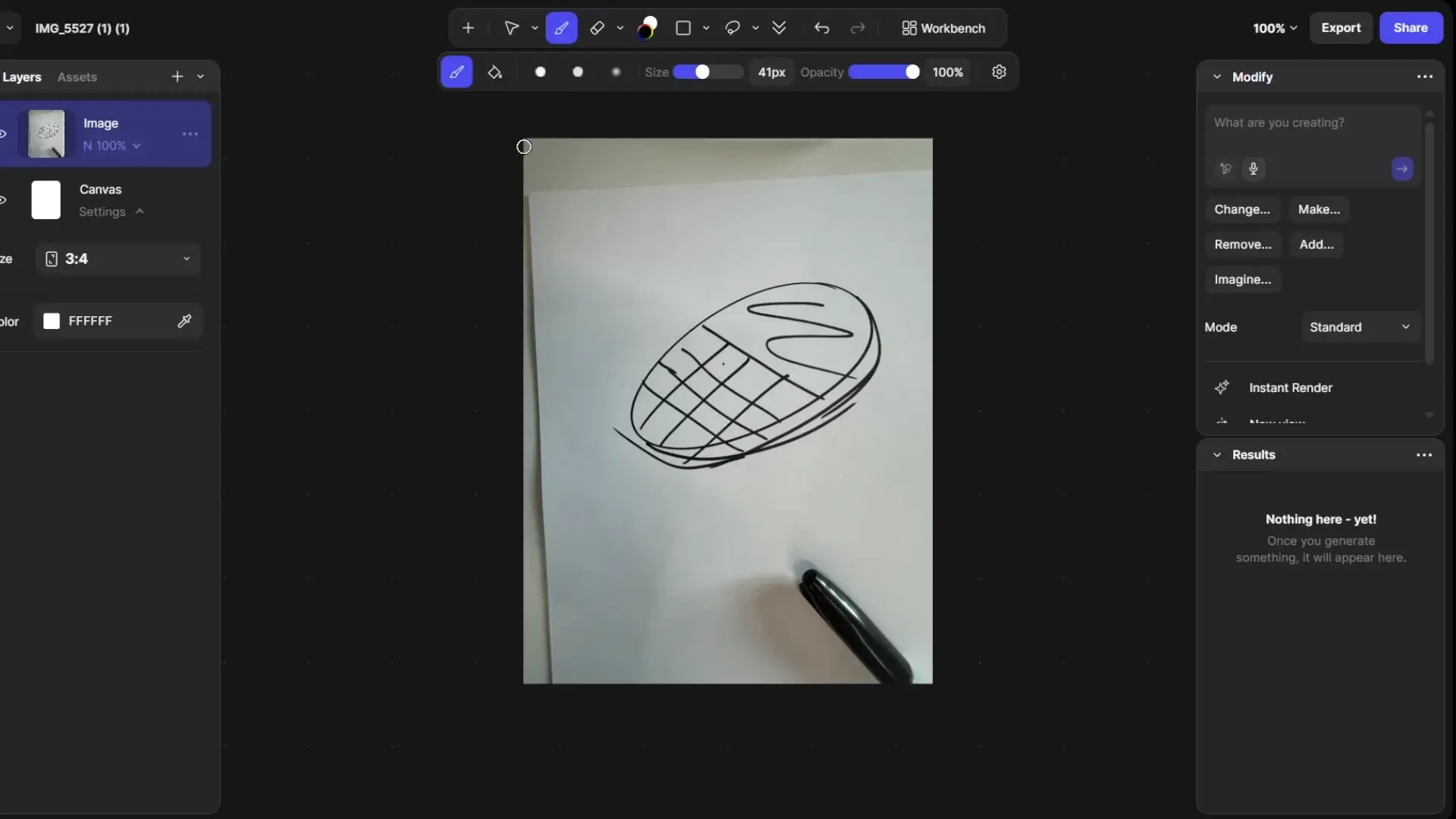
What was just a thought becomes an artifact we can talk about—and they can respond to. What feels right? What feels off? Which details carry the emotion of the idea? What did the generated version misunderstand?
This last question is often the most useful, because a mismatch can reveal what mattered in the original input, even if the participant couldn’t articulate it at first. This is particularly important when we’re designing something totally new, something people haven’t seen or experienced. It’s not always easy to uncover the thing that’s driving thoughts, feelings, or behaviors—even when they’re your own.
On a project designing an agentic AI solution for a financial services client, for example, our team used AI to generate personalized prototypes that pulled real data and context from each participant’s interview in real time.
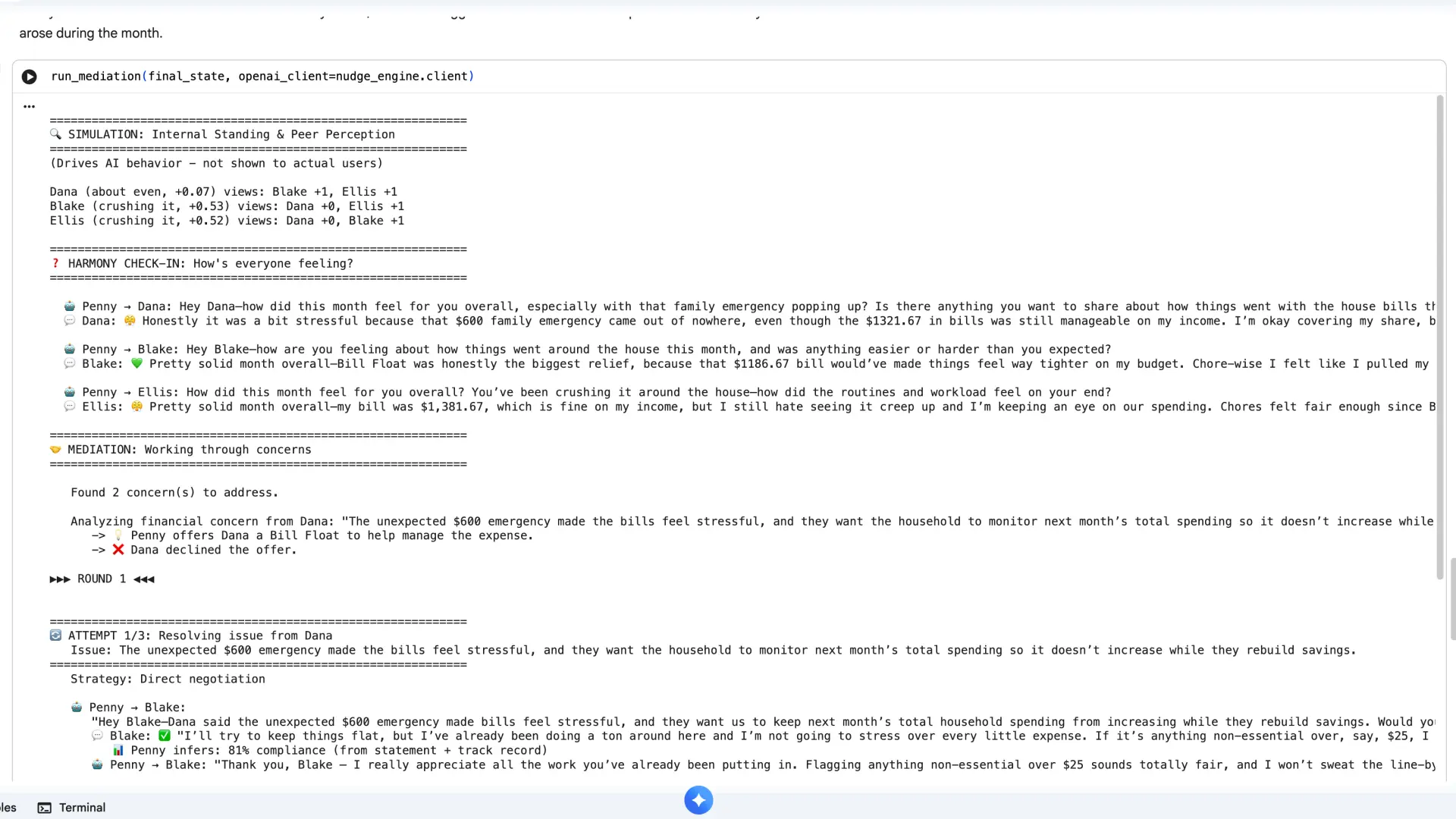
This level of personalization made our futuristic concepts feel like real tools they might use, making it easier for them to provide meaningful feedback about how they would or would not drive the behaviors our client was interested in.
Used in this way, AI is doing more than simply summarizing and clustering—it’s helping us tune our conversation to the right level of depth, at the right moment in the research, so that we can better prompt participants to uncover their real motivations and behaviors.

3. Challenge our assumptions
This mode is at the other end of that spectrum from using AI to go as fast and as big as possible. Here, we’re leaning into AI’s ability to talk back, to push and challenge us, to consider our perspectives and introduce new ones. It can also help surface our biases. We shift into this mode when we need AI to serve as a pressure-testing partner that can critique a recruiting plan, push on a discussion guide, look for overreach in early insights, or evaluate an opportunity area against business, technical, ethical, or ecosystem constraints. It can also help us feel the limits of an idea before it gets too much momentum and while we can still change it.
Our research process starts by framing questions as hunches we can prototype. The art of the craft here is articulating our assumptions clearly enough so that we can see them—and our research participants can, too. This can be hard for humans alone, because our assumptions and biases can be invisible to us. AI can help us see what’s too close to see ourselves.
A few years ago, we were working with a large multinational company to understand what motivated employees across different cultures and countries. We conducted employee interviews and then set out to synthesize the findings into insights to help motivate new behaviors and ways of working. As an experiment, we trained an LLM to analyze the interview transcripts and provide its own take. Its findings were very similar to ours. But using AI in this way required our team to be explicit about what we meant by motivation. Definitions can vary by culture, so we needed to consider what that could mean for our work. The process of making a subjective idea concrete helped us see its limitations. It wasn’t the fastest way to the answer, but it challenged us to try on different perspectives and introduce some friction that encouraged us to be more thoughtful and ultimately confident in the relevance of our learnings.
So sure, AI can make research faster. But remove all the friction, and we might just remove the engine of real learning.

4. Immerse us in data and context
Our fourth and final mode is about bringing research material to life so that people can engage with it in a format and medium that matches the purpose. That can mean turning a report into a navigable website, making a podcast version for senior stakeholders, or training a custom research agent that a design team can query while building a new feature long after the project has ended.
IDEO’s Big Questions Bot is a good example of this mode in action. It’s an AI tool we built to crowdsource perspectives on a set of big questions to guide an internal research effort. How might we leverage technology to fight the climate crisis? How might we rewrite the rules of collaboration to reflect the new norms? How might we bring more presence, care, and connection to everyday interactions?
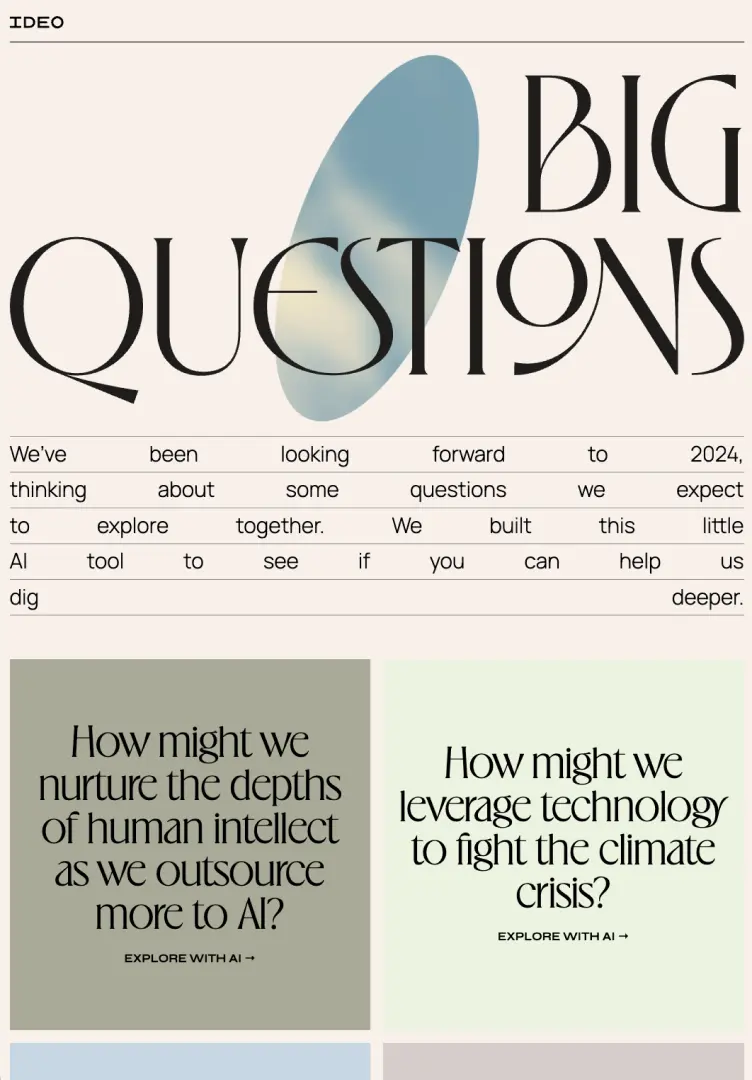
We invited the public into conversation with it and us. As the people reacted and reframed each question, the bot made revisions to better reflect each person’s context and perspective.
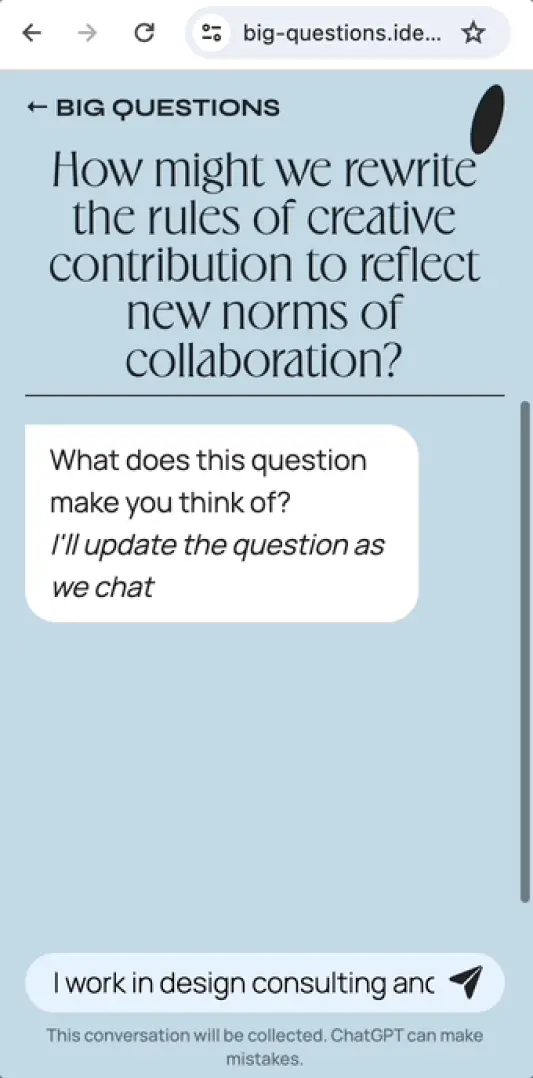
What we got was a richer and more robust set of questions than we could have ever come up with on our own.
When it came time to analyze the results, we once again used AI to help us structure the messy data these conversations generated and translate it into a 3D vector space that connected themes across and between conversations. Much like moving around a physical environment peppered with Post-it Notes, we could step inside our conversation space, look around, and draw connections. Beyond understanding which questions had the most energy behind them, we got a peek at the connections people were drawing between them, and the connections they were making to their own lives and contexts.
This kind of tool blurs the boundary between research and design in a productive way. It creates new opportunities for us to engage with and communicate complexity and invites people to enter, question, and reshape our work. Here, speed does matter, but it’s speed in service of understanding—at the right time and in the right format to act on it.
How to use the matrix
Instead of using the 2x2 as a prescription, we think of it as a generative framework that helps us consider and navigate the vast technological possibility AI opens up for research. It helps us intentionally define the relationship we want to build with AI at each moment, and consider how we might move between these modes across our research process, before we reflexively turn to a tool.
In some ways, AI gives us more opportunities to spend more time where it counts—framing, exploring, and sensemaking. But that also raises the bar for the humans in the system. We need to get better at setting constraints, designing feedback loops, and knowing when AI is helping versus flattening the nuance.
As researchers working at this historical moment, we have the incredible privilege—and maybe overwhelming responsibility—of building the playbook that defines how AI should be used in research, where it truly adds value, and where it doesn’t. AI can make research faster, sure. The more durable use case is helping us become more curious, more rigorous, and more honest about what we are seeing.
Interested in exploring the future of human-centered AI design research with us? Get in touch.
Heading 1
Heading 2
Heading 3
Heading 4
Heading 5
Heading 6
Lorem ipsum dolor sit amet, consectetur adipiscing elit, sed do eiusmod tempor incididunt ut labore et dolore magna aliqua. Ut enim ad minim veniam, quis nostrud exercitation ullamco laboris nisi ut aliquip ex ea commodo consequat. Duis aute irure dolor in reprehenderit in voluptate velit esse cillum dolore eu fugiat nulla pariatur.
Block quote
Ordered list
- Item 1
- Item 2
- Item 3
Unordered list
- Item A
- Item B
- Item C
Bold text
Emphasis
Superscript
Subscript



.jpeg)