











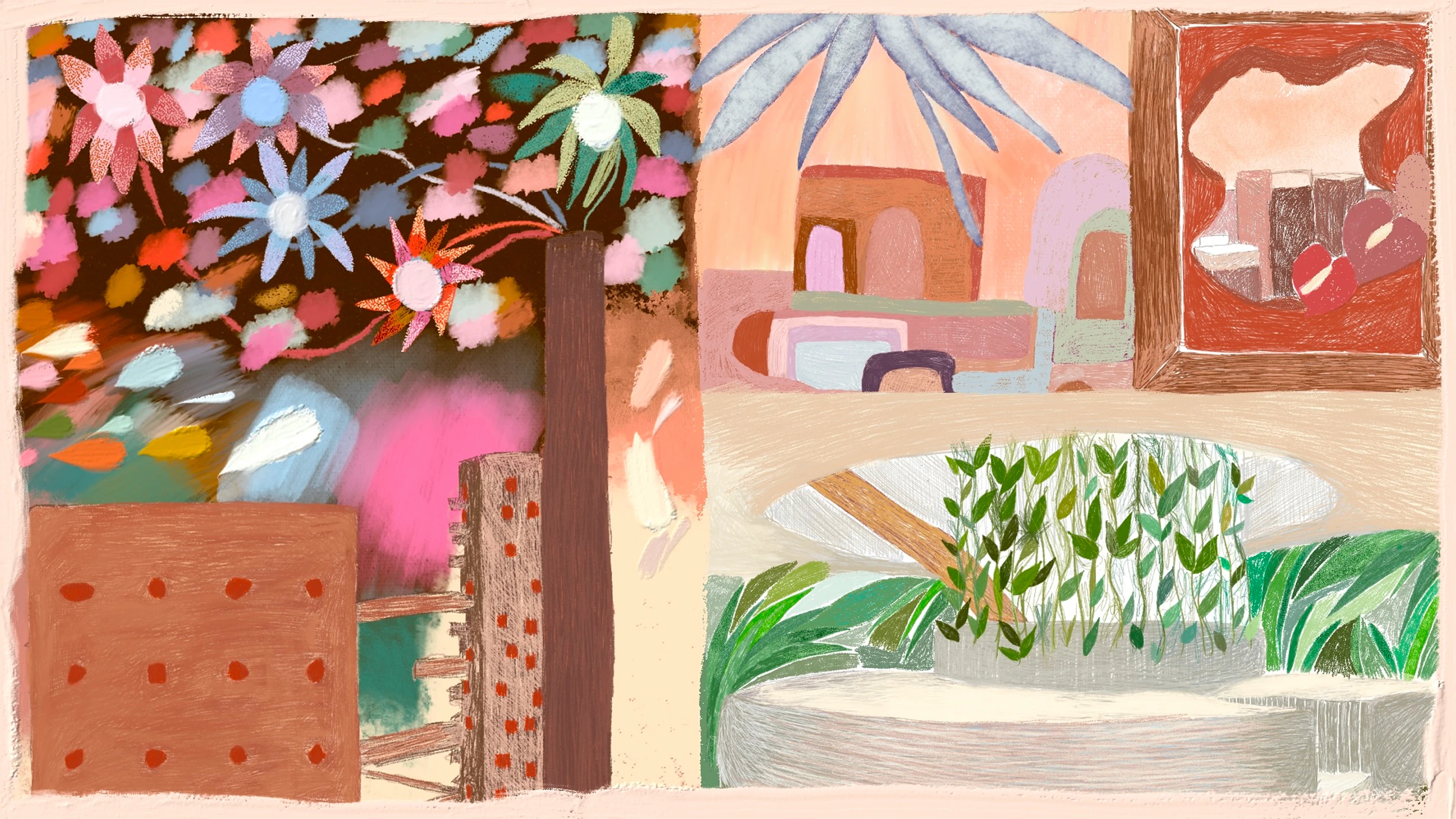

Designed by the Italian architect Lina Bo Bardi in the late 1970s, the leisure, culture, and sports center looked and felt exactly like her sketches brought to life: teenagers reading, women barbecuing, children playing soccer, and adults watching lectures. Bo Bardi’s design helped weave a social fabric, one that held a full spectrum of life through the choreographies of every generation.
Lina Bo Bardi was a student in Italy during World War II. Studying the art of constructing buildings during a time of mass destruction was not lost on her. Bo Bardi describes this period as, “Nothing was built, everything was destroyed.” The era signaled a critical reassessment of how to rebuild and how to live in a world of relics and ruins. When it was over, Bo Bardi and her husband, both members of the resistance, found postwar life difficult and immigrated to Brazil.
Twenty years later, Bo Bardi designed the now iconic SESC Pompéia. To many, the overlooked site was simply an old metal barrel factory. But she saw potential. Instead of tearing down the former factory, she bridged its two concrete towers with striking, zig-zagging diagonal walkways. With this simple yet remarkable connective architectural tissue, she created a welcoming and enduring public complex with a generational gravitational pull.
Designing for intergenerational connection means designing with the full arc of time in mind; to build worlds with the tender ambition to instill awe and foment wonder in future generations. It’s an ethos I find inspiring. I grew up in the Philippines, in the city of Pampanga, enjoying the elasticity of slow tropical heat while listening to my grandparents share everything from war stories to town gossip. My memories of them shaped me as a person and a designer, and inspired me to follow Bo Bardi’s example. To understand how to create a blueprint for intergenerational spaces, I spoke to three experts who have spent their lives inhabiting and making them: Yuriko Yamaguchi, a Director at Inner Chapter, an insight and strategy firm in Tokyo; Lara Vainer Schucman, an independent qualitative research consultant in Brazil; and Dr. Jane Varner, Primary Care Medical Director of Cottage Health in Santa Barbara, California.
Their insights, together with my own experience as a designer and former architecture student who builds to think and thinks to build, informed a modular set of design principles that can be rearranged, added to, and handed to the next person who needs them.
1. Leave space for generations you will never meet
My background in architecture instilled a fundamental belief: You must design with the awareness that there are future generations you will never meet who will inhabit the space you’re creating. One of my first projects at IDEO tackled this directly: a redesign of Grand Park in Frisco, Texas. My team and I led workshops with park visitors from across generations to learn about how they use the park and their hopes for what it could become. Then we asked them to imagine a future memory they could share with the youngest person at the park. The question implies a truth: The spaces we design and inhabit will require the caretaking of future generations. It’s up to us to model that kind of tending.
I put a similar question to the experts I interviewed: “Think of the youngest person you know. You are gifting them a happy memory, whether in a dream or in a real intergenerational space. How do you imagine them using the space?”
For Vainer Schucman, the research consultant in Brazil, that takes the form of a memory forest:
“I imagine the youngest person I know walking through this memory forest. I see them pausing under a grand tree, touching its bark, and hearing the story of the ancestor who planted it decades ago. I imagine their eyes lighting up with wonder as an elder teaches them how to identify a specific fruit for food or a leaf that can heal a wound. I want them to use this space to feel that they are never alone; they are constantly supported by the wisdom of their ancestors and the bounty of the earth.”
Yamaguchi envisions a space where the knowledge held by elders doesn’t disappear when they do. The people themselves become the archive:
“I envision a living library and cultural hub nestled within a forest of memories, where people are the primary books. This space would be surrounded by trees that tell the history of those who planted them, serving as living records of the past.”
Both visions share the same instinct. The most powerful intergenerational spaces don’t just bring people of different generations together; they make generations visible to each other. The tree tells you someone was here. The bark under your hand is a kind of conversation.
When loneliness becomes a public health epidemic, weaving the past to the present is not an act of decorum. It is a lifeline—one that can help us understand how we got to the world we live in today and develop hunches about what our future could be.
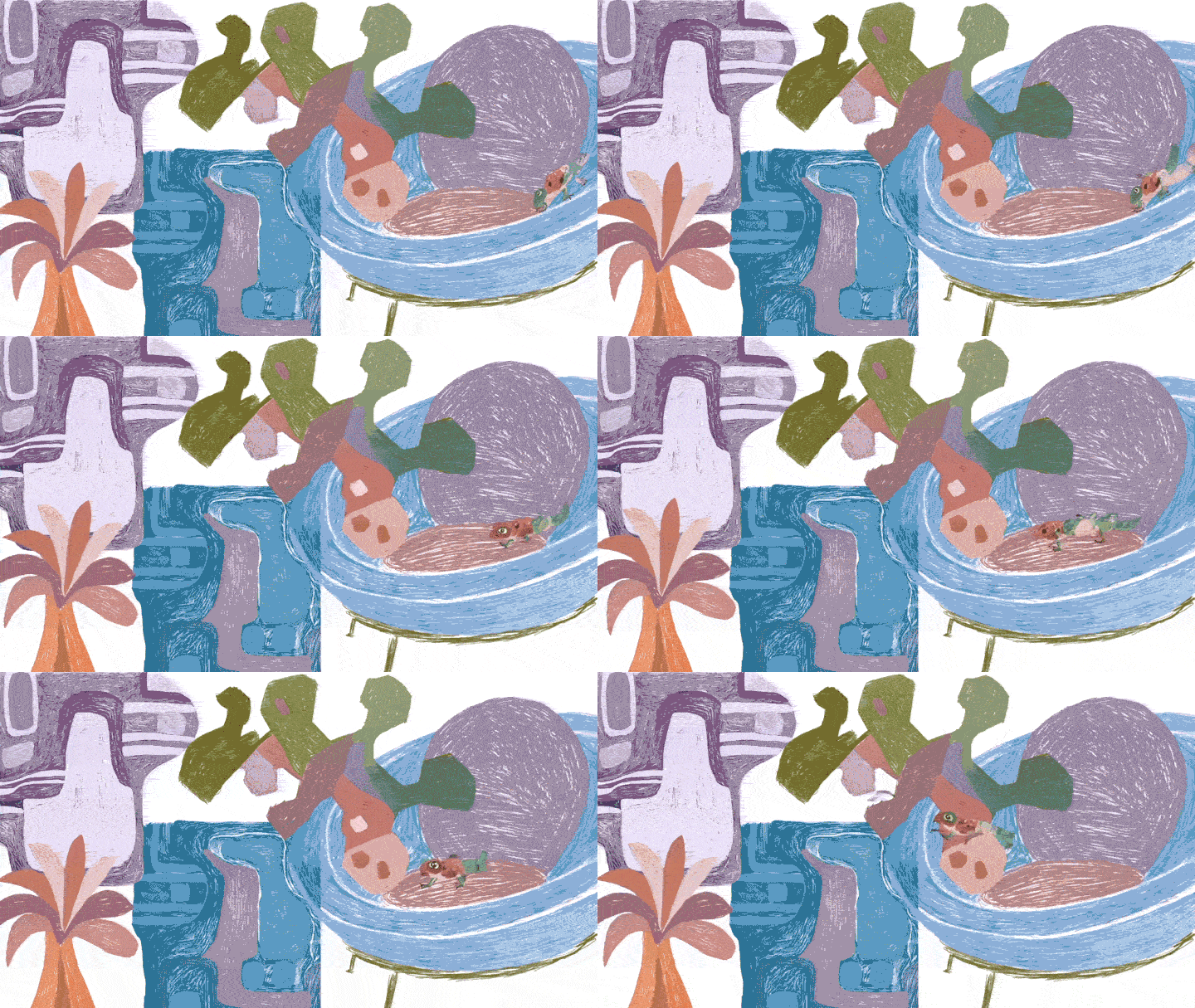
2. Let multiple hands sculpt the clay
“I’m proud to say that my favorite intergenerational space is my home,” says Yamaguchi. “We currently have 10 households living together—a couple, a single mother and her child, a family of five, a four-generation family, and an elder with her feline companion. Some say it’s a cutting-edge experiment, while others say it’s like a village from the good old times."
Around the world, cultures have long been built around intergenerational activities and concepts. In Japan, there’s murashigoto or village work, in which a group gathers for food-related tasks such as salt-making, plum-picking, loquat-gathering, miso-making, and rice-planting. The work of multiple hands across generations underpins this form of seasonal collective labor. For Yamaguchi, the most radical intergenerational space she knows is also the most ordinary.
She says, “The elders are dexterous, the middle-aged people are tough, and the children are playful.” Each generation brings what the others cannot, and the space only becomes whole when all of them show up. This isn’t just how food gets made. It’s how spaces accumulate meaning through the layered presence of different bodies, at different stages of life, tending the same ground.
My grandmother’s garden was a 50-year work in progress. Generation after generation of our family tended it—she and her children in the 1960s and ’70s, and her grandchildren through the ’80s and ’90s. Our feet learned the same soil at different ages. My living childhood memories are the landscape inside of my head; the scenery greets me with rows of pink and purple hibiscus flowers and orchids standing tall in deference to the heat. Beneath them, the soil is carved into tender, careful lines, the product of my grandmother’s disciplined tending.
This is what great intergenerational spaces ask of us: not to design them once and call them finished, but to keep showing up, season after season, and add our hands to the ones that came before.
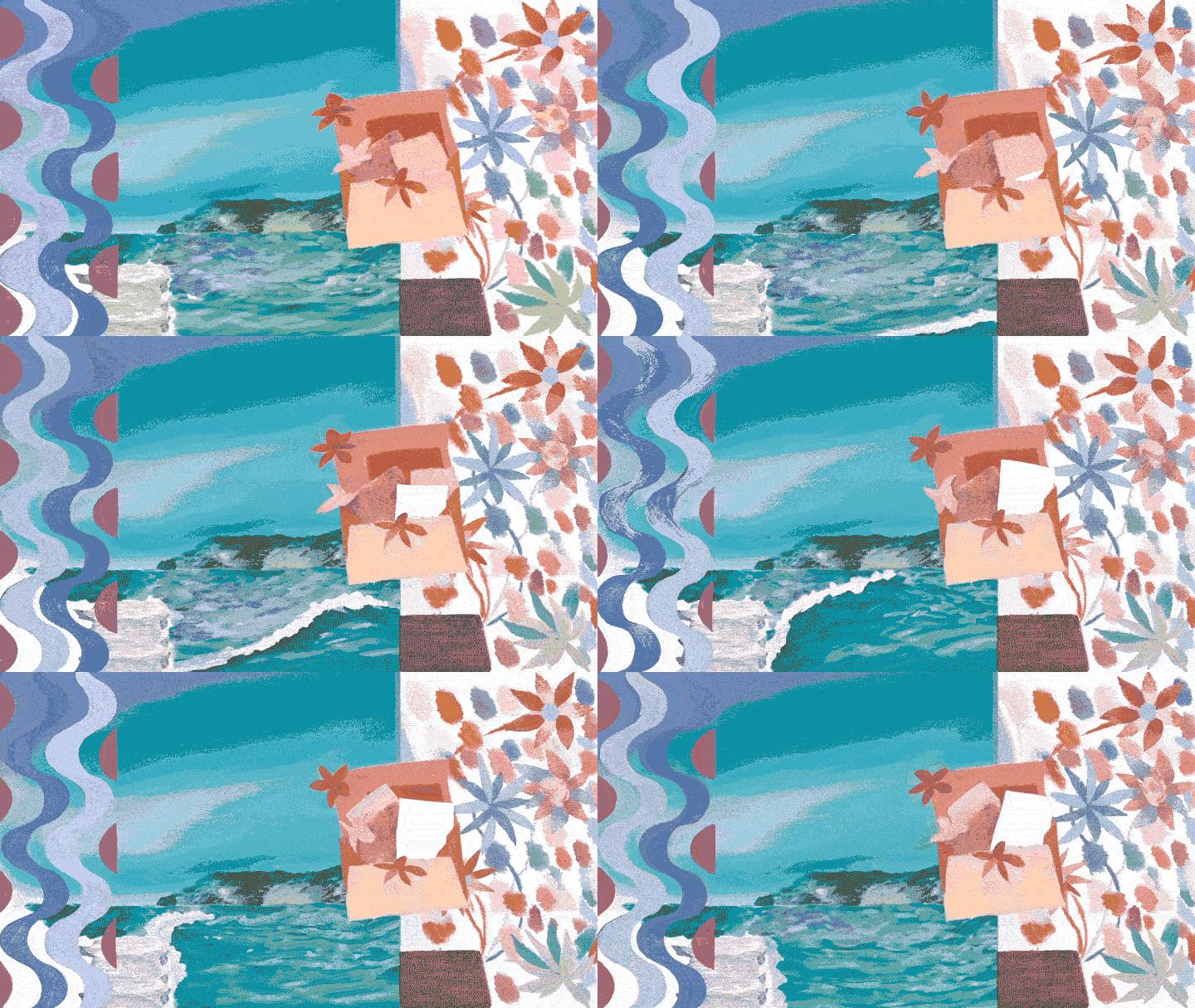
3. Go where life already gathers
As a design researcher, traveling only heightens my inclination to recognize patterns and connect dots. Recently, I’ve become attuned to the ways we organize ourselves when we gather. I’ve seen different generations coming together in intimate, everyday, seemingly transitional spaces. In Tokyo, I felt the post-work pulse of crowded izakayas; in Brazil, I saw people from various generations dancing to the rhythm of life in samba bars; in homes in Santa Barbara, women talked about holding their communities together at kitchen tables.
Vainer Schucman describes the roda de samba, or samba circle, as a space where cross-generational encounters happen organically in rhythm and tempo. Teenagers and grandparents find a shared beat without introduction. Age dissolves into the music, and what remains is the circle itself. What emerges is the hope of aging without loneliness, as participants dance, clap, sing, and enjoy the warmth of the day until the nighttime breeze cools the air.
In Santa Barbara, Dr. Varner views the ocean as her intergenerational lifeline, beginning with a love of surfing that her parents passed down to her. Life felt off balance after her mother was diagnosed with cancer. There wasn’t time for surfing. But before her mom passed, she urged Dr. Varner’s dad to promise he would return to the water. They bought him a new wetsuit and a surfboard and made their way back. Sometimes, while waiting for the next wave, they are joined by a seal that Dr. Varner jokes is her mom. “My mom was, of course, right. The return to surfing has been my dad’s lifeline.”
The ocean doesn’t sort by age or by who got there first. Dr. Varner wants the young women in the water to know that, and to carry it with them to whoever paddles out beside them next. “It’s important to have a healthy respect for the inevitability of aging. People often disengage from the things they love to do simply because the logistics become more complex. It is incumbent upon younger generations to make an effort to ensure that the older generations remain engaged.”
One of the most overlooked building blocks isn’t something we can engineer or prepare for. It’s about being open to chance: designing spaces welcoming enough for a grandmother and a teenager to find themselves at the same table, in the same dance circle, or riding the same wave.
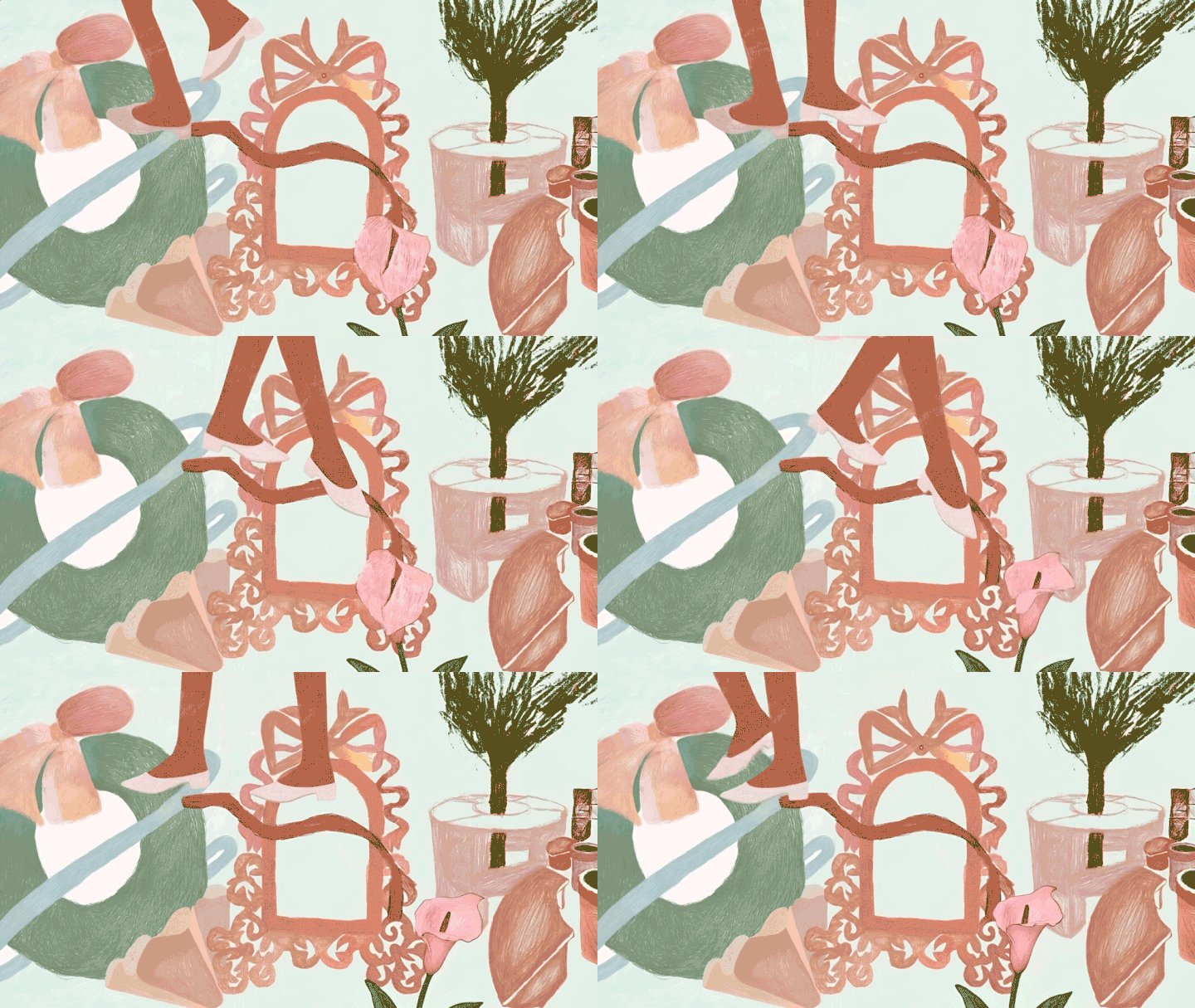
4. Make care the invitation
Tertulias are informal gatherings held in Spanish cafes and bars where people come together to exchange ideas and discuss various political and cultural topics. Tertulias originated in the 1960s and ’70s, when South American expats in Barcelona gathered to share stories from their home countries. Their discussions and debates were molded, shaped, fragmented, and reconstructed there.
I was introduced to this way of gathering by my Spanish teacher, Sra. Santiago. She believed art and literature are how we time-travel to meet each other. Tertulias taught me how to loosen fixed generational boundaries and truly engage with people and ideas across ages.
What tertulias and the most enduring intergenerational spaces have in common is that their design invites engagement. A successful intergenerational space feels welcoming. It allows people to wander free, not because they were instructed to, but because the space feels intentional, cared for, and considered. It subconsciously makes them feel safe enough to discover it on their own terms.
Yamaguchi refers to this as a “bonsai mountain” moment, or stumbling upon a hidden gem in a residential area; an unexpected gift for uninhibited wandering and unfettered curiosity. She hopes to instill a sense that this space is intentionally designed, spooled like a masterful spiderweb that creates just enough openness to support each generation across life stages, and to see themselves as equal parts architects and caretakers, keeping the space alive.
Making care the invitation is what Bo Bardi saw in the abandoned factory, what Sra. Santiago insisted on each time she handed me a new idea worth sitting with, even at 15 years old, and what every great intergenerational space understands. Care is not left at the door. It is the blueprint.
These intergenerational spaces are part of my creative lineage. The way I see the world was assembled from modular building blocks I began collecting as a child in my grandmother’s garden in Pampanga. They were sculpted as a teenager in a Spanish classroom that taught me how to time-travel through art and literature, and continue to be shaped by the izakayas, samba bars, large parks, and other intergenerational spaces I encounter and design today.
Designing through an intergenerational lens is an integral piece of myself that I see reflected in every space. It is the ground I keep designing from. These building blocks are not static. They are a living inheritance. To be rearranged, added to, and passed down to the hands that sculpt the clay next.
Heading 1
Heading 2
Heading 3
Heading 4
Heading 5
Heading 6
Lorem ipsum dolor sit amet, consectetur adipiscing elit, sed do eiusmod tempor incididunt ut labore et dolore magna aliqua. Ut enim ad minim veniam, quis nostrud exercitation ullamco laboris nisi ut aliquip ex ea commodo consequat. Duis aute irure dolor in reprehenderit in voluptate velit esse cillum dolore eu fugiat nulla pariatur.
Block quote
Ordered list
- Item 1
- Item 2
- Item 3
Unordered list
- Item A
- Item B
- Item C
Bold text
Emphasis
Superscript
Subscript