










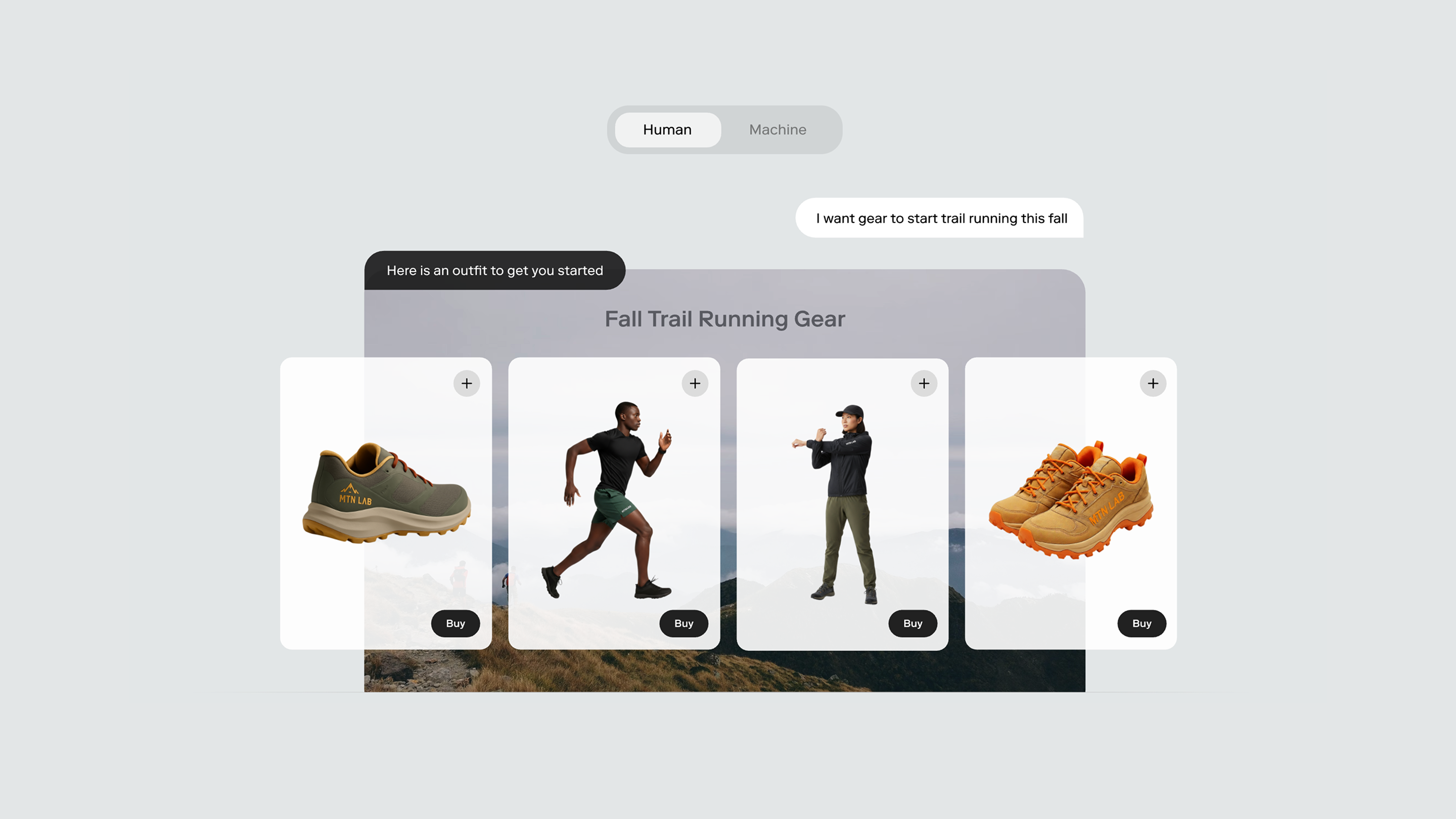

AI agents behave differently. They do not need a homepage. They do not wander through navigation menus or respond to visual persuasion in the usual way. They arrive with a goal, a set of constraints, and a request expressed in language. Arena argued that this requires a new model for websites: one layer for human shoppers, and another semantic layer that machines can understand and act on.
New Generation’s AI Storefront is built for this second layer. Using protocols such as MCP and real-time page generation, it can produce shopping experiences in response to natural language queries: product grids, comparison tables, recommendations, and checkout paths assembled on demand. The value is not simply that this is faster. The value is that the system can adapt the presentation to the user’s actual task.
But the design problem is not only technical. It is also about meaning and control. If AI systems become the intermediaries between shoppers and brands, then brands must ask: what exactly does the agent understand? What does it preserve, simplify, distort, or ignore? A brand that cannot be represented clearly in machine-readable form risks losing its identity in the transaction.
The second session introduced Agent Score, a tool for evaluating whether a website is ready for AI agents. It sends agents to ask increasingly complex questions and measures how well the site’s data structure supports those interactions. A conventional website may take minutes for an agent to interpret. A semantic storefront can answer in seconds.
This reveals a familiar lesson in a new setting: a system that works well for one kind of user may work poorly for another. The current e-commerce site may look usable to people but be nearly unusable to machines. From an agent’s perspective, much of today’s web is not an interface. It is clutter.
Arena’s larger argument was that brands need brand intelligence: structured knowledge about products, values, fit, use cases, policies, and identity. This knowledge must be available to AI systems without reducing the brand to generic inventory inside someone else’s platform.
The sessions framed agentic shopping as a problem of design, not just automation. The question is how to make systems understandable, trustworthy, and controllable when the “user” may be both a person and an agent acting on that person’s behalf. In this new environment, being discoverable is not enough. Brands must be understandable, actionable, and accountable.
.png)

