








(Prefer to listen to the story? Click here.)
I’m a proud, card-carrying member of the Heated Rivalry fandom. After rewatching the episodes on HBO Max thrice, I found myself spending $50 to attend a sold-out Heated Rivalry Night hosted by LA-based party promoter, Club 90’s.
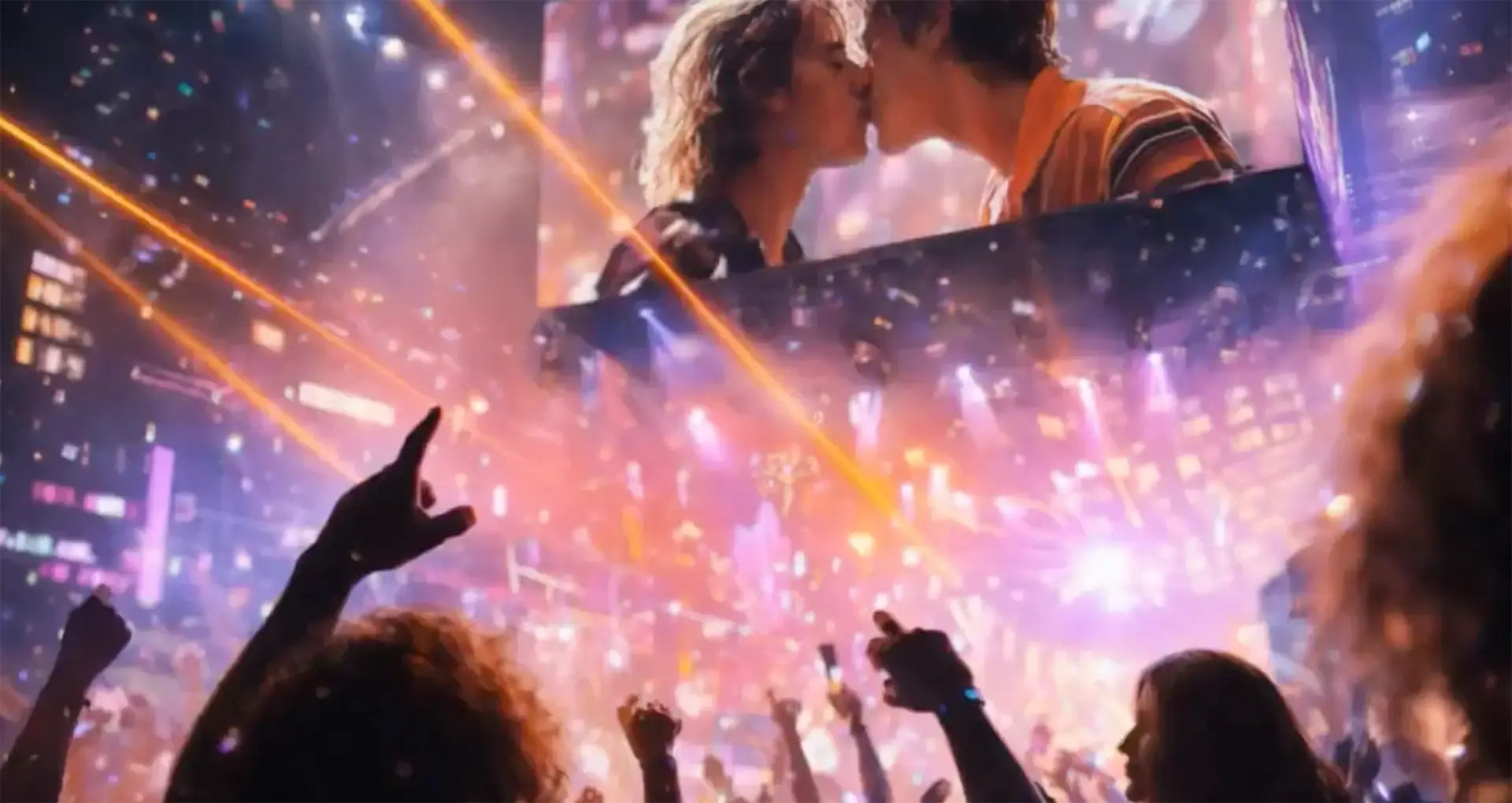
The moment I stepped into the venue, a wall of sound crashed into me. An all-ages crowd screamed in unison at an intimate scene from the show flickering across a massive screen. It felt a bit dramatic, but by the end of the night, I was jumping up and down, yelling “All the Things She Said” by t.A.T.u. & Harrison—a song on the show’s soundtrack—with my friends, hand in hand.
Real talk: There was nothing technically groundbreaking about this event. The “DJ” wasn’t doing much more than pressing “next” on a playlist.
But damn, did I have fun. And I wasn’t alone; Club 90’s Heated Rivalry Nights have expanded beyond Los Angeles to more than 100 pop-ups across the country.
No HBO exec approved this. The fandom built it and charged admission.
The insatiable fan appetite
When a new season drops on streaming services, I do what most of us do: I binge it in one go. Clicking “next episode” gives me a consistent stream of dopamine until suddenly, the series is over. But finishing a show isn’t the end; it’s just the beginning for superfans like me.
After turning off the TV, I have compulsive cravings to dig deeper into the lore, know more about who the real actors are beyond the screen, and, of course, their off-screen chemistry. YouTube videos like Heated Rivalry star Hudson Williams’s 24-minute unedited Korean skincare routine on The Cut, and his costar Connor Storie’s dance to Madonna’s “Like a Prayer,” do the trick.
But eventually, even this food source runs out, because official brand-sponsored content is finite. Fandom, however, and what we can co-create, is infinite.
When memes become products

The Heated Rivalry Night was really just fragments of the internet stitched together into an in-person audio-visual experience: memes, fan-made clips, YouTube videos, and of course, song remixes of repeating the show’s most-quoted line: “I’m coming to the cottage.”
Partygoers were even recreating a crucial scene between the main characters, Iyla Rozanov and Shane Hollander. I realized that the memes I used to consume on my phone while bedrotting (Gen Z slang for scrolling in bed for hours) had escaped the confines of the World Wide Web and taken physical form. And they’ve now evolved into products that fans will pay to experience in-person.
I call this shift memes-as-a-product (MAAP). And the question of who owns and profits from these products is now consequential for brands.
Don’t try to control memes; curate them
Historically, brands have treated memes as a marketing tactic, wading into culture to insert themselves and, at times, steer the narrative.
When Jaguar rebranded in 2024 with car-free, avant-garde visuals, the internet immediately turned it into a meme: Teletubbies comparisons, Benetton jokes, Elon Musk asking “Do you sell cars?” In response, their CEO declared the backlash “vile hatred and intolerance,” attempting to control the memes. The public backlash only accelerated, and sales sharply declined.
On the other hand, the recent resurgence of millennial icon Hilary Duff is a best-in-class case study of how curating memes into fan-centric experiences can sell out a world tour.
Fans turned her choreography for the 2007 song “With Love” into a meme about “giving us nothing.” It resonated with fans as its low-energy performance made her seem relatable—like one of us average civilians.
She could have reacted by attempting to control the narrative, or, worse, by being publicly offended. Instead, she leaned in, featuring the meme as an interactive fan dance moment in her new “The Lucky Me Tour.” It sold out. She added dates.
Fans aren’t just showing up to hear her hits; they’re paying to recreate the meme.
People are learning the choreography weeks before the show with the hopes of being magically plucked from the crowd to reenact the meme with Hilary Duff herself.
As one fan said on Reddit, “I love her leaning into this as a fan interaction experience. I think more celebrities engaging with their awkward memes and reclaiming them is a smart branding move. Makes them seem like they are humble and can take a joke.”
Hilary Duff’s approach is the new blueprint. And McDonald’s CEO would probably agree.
After becoming a viral meme while taste-testing the chain’s burgers, Chris Kempczinski responded in a Wall Street Journal interview: “This notion that you can control everyone is not how it works anymore… The consumers, or our guests, are actually just as much in control of our brand as we are.”
Kempczinski gets it. Fans are no longer just consumers, but co-creators. And the smart brands that want to curate revenue-driving memes-as-a product will honor that.
Don’t simply extract meme value; share it
When brands rush to monetize a meme they didn’t create, it can backfire. When their community’s inside joke has been hijacked by an outsider, superfans see it as a cash grab.
Take Luke Thompson, who plays Benedict Bridgerton, the lead character in season four of Netflix’s blockbuster show Bridgerton. During a promo interview, Thompson went viral for a simple mistake. He thought the abbreviation “ISTG” stood for “Instagram” instead of “I swear to God.” The clip swirling around the internet shows his co-star, Yerin Ha, bursting into laughter in response.
It became meme fuel fast.
And then, the Netflix Shop turned it into merch. Some fans loved it, but others were upset. To some, what had once been a shared, organic inside joke suddenly felt like it had been co-opted.
Some fandoms believe that memes don’t belong to brands. As Quihao Huang and Yanxue Zou, two doctoral students from Shenzhen University in China, state in their article on fandom in Frontiers in Psychology: “Platform mechanisms amplify the visibility of individual actions, and elements such as support posts, trending topics, and fan activities are treated as digital territories that must be protected.” Fans can develop a strong psychological sense of possessiveness and protectiveness, especially when their ownership feels threatened.
For example, as one Redditor said, “As soon as companies capitalize on something that was cute fun amongst the people, it immediately gives me the ick.”
So what if brands built platforms that enabled co-ownership with fandom?
Take Heated Rivalry Night, for example. Attendees were not only showing up with custom-made hockey jerseys, trading cards, and friendship bracelets, but they were also trading them. One Redditor said, “I went to one last night. It was awesome! I made bracelets, and someone gave me an Ilya keychain and photo card.”
The fandom is already operating as its own merch engine by creating, distributing, and signaling demand outside official brand channels.
If brands can’t stop grassroots marketplaces from organically forming, why not join and elevate them?
Imagine a merch shop that looks less like a traditional storefront and more like Etsy meets Printify. Instead of only selling official merch, what if brands partnered with fans to bring their creations to market, using corporate infrastructure to ensure quality, scale distribution, and minimize brand risk?
The result: a world where UGC is no longer just about user-generated content, but user-generated commerce. A future where fans don’t just remix IP and culture but are rewarded for building on it.
The real reason memes-as-a-product matter: human connection

When done poorly, memes-as-a-product land like Barbie Dream Fest or the Bridgerton Ball in Detroit, both location-based entertainment experiences decried as scams.
When they are thoughtfully designed and executed well, however, MAAPs don’t just entertain. They create much-needed third spaces that cultivate human connection. And in a world increasingly marred by isolation and loneliness, these fandom-centric experiences might be exactly what we need more of.
No longer will we be limited to cackling alone, doomscrolling on Instagram (not to be confused with ISTG) at an ungodly hour. Now, we’ll be able to physically step inside them.
As memes expand beyond cultural artifacts into monetizable products and experiences, the brands that curate them as co-owned assets will be the ones who win.
And who knows? What simply starts as a joke might serendipitously turn into you meeting your very own Rozanov. Or Hollander. Take your pick.
Interested in exploring the future of media and entertainment together? Get in touch.
(Bell Media owns the intellectual property rights to the Heated Rivalry television series, produced by Accent Aigu Entertainment in association with Bell Media’s Crave. The series is based on the book series Game Changers by author Rachel Reid.)
Heading 1
Heading 2
Heading 3
Heading 4
Heading 5
Heading 6
Lorem ipsum dolor sit amet, consectetur adipiscing elit, sed do eiusmod tempor incididunt ut labore et dolore magna aliqua. Ut enim ad minim veniam, quis nostrud exercitation ullamco laboris nisi ut aliquip ex ea commodo consequat. Duis aute irure dolor in reprehenderit in voluptate velit esse cillum dolore eu fugiat nulla pariatur.
Block quote
Ordered list
- Item 1
- Item 2
- Item 3
Unordered list
- Item A
- Item B
- Item C
Bold text
Emphasis
Superscript
Subscript