



We’re talking about writing in the age of AI. So where do we start? By asking AI, of course:
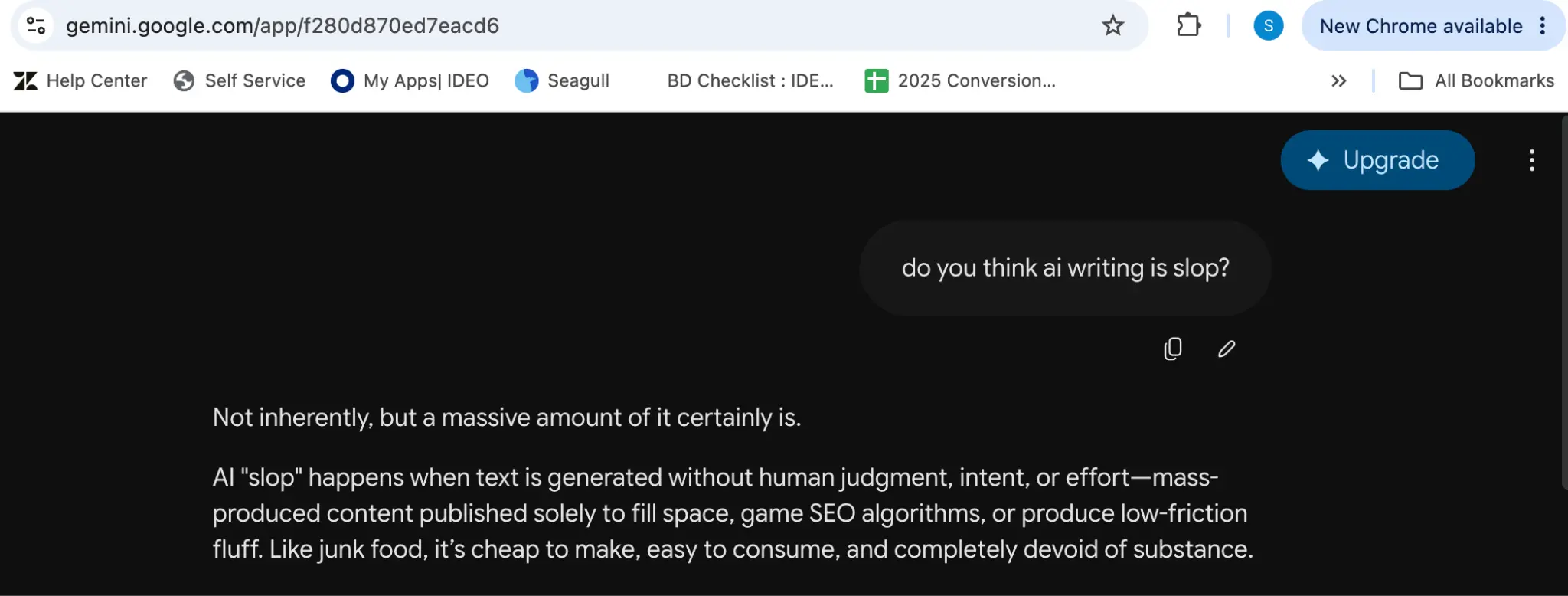
I couldn’t have said it much better myself, robot. Without human judgment, intent, or effort, writing isn’t writing—it’s just words.
I’ve been a professional writer for two decades, and for the last several years now, people have been telling me that someday I will not have a job. “Writing is easy for AI,” they say. Everyone can write. Most of us have written personal essays, emails, and notes. Some believe writing isn’t as much of a craft as, say, painting or creating professional-level products in design programs for clients. I disagree, but as I’ve come to notice even at my own office, AI writing is showing up in more and more places, and wow, it’s bad.
But why is AI writing so bad?
AI is trained on corporate drivel, so it’s no wonder it sounds like it.
The same risk-free, corporate jargon-filled nonsense we’ve seen in so many boring decks is now multiplying because of AI. We are seeing it everywhere. Without strong prompting or humans doing critical thinking and editing, AI writing defaults to repetitive phrases, buzzwords, and vague, overly polite transitions. And so many em dashes; I’ve started to use fewer myself, and it’s one of my favorite punctuation marks.
AI doesn’t form original thoughts, remember?
The AI most folks use to write these days runs on large language models (LLMs) that take vast swaths of content, draw on existing human knowledge, and just reorganize it depending on the prompt. It doesn't form original opinions. It can’t draw from personal lived experience, or take real creative risks on its own. All it can do is pull from what’s already out there, so nothing it creates is innately new. Perhaps that’s why AI writing has a certain dryness that feels particularly insulting to writers.
It is also overly dramatic. You might be making a small point, and it’s going to tell your audience to read that again. Or that your argument is what most people don’t understand. Full stop. And when writing puts a lot of imperative weight on something like, say, the best way to send a newsletter or the only way to build a deck, your writing is going to start to sound a little silly. Let that sink in.
So, what are some rules for writing well with AI?
“Never give away that messy first draft.”
Ed White said something like this on an episode of the Creative Confidence podcast called “How to Use AI as an Editor, Not a Writer,” and it resonated with me. As a writer, I can’t imagine wanting to let anyone else, including an LLM, own my first draft. The first draft is the friction, the grappling to wrestle a jumble of thoughts into something that makes sense. It’s how we get our thinking down on that first blank page. That is also the moment where you stress-test your ideas, asking. “Is this a real thing, or do I need to keep working to get it into better shape before I share more?” This is when you figure out where the real ideas are, what you’re really talking about or solving. That is writing. It’s also the first step of design. Give it up, and you’re just outsourcing your thinking.
Get into brevity.
“I would have written a shorter letter, but I did not have the time.”―Mark Twain
We see this quote all the time, misattributed to Mark Twain online, but actually, it was Blaise Pascal in 1657. (Mark Twain did write in a 1871 letter that he was "so apt to get to slinging wisdom and forget to let up.”) Have you noticed that brevity is not something AI writing does well? I have. Heed the advice of Strunk and White in The Elements of Style: “Omit needless words.” AI could never.
I recently took some time off from work, and when I came back, I was shocked to see how bad writing had gotten; how prevalent AI writing was; all over emails, social media, even in our work. When we didn’t have a writer, we used robot friends to help the process along—and it showed. The writing was boring, had no flavor or personality, and wasn’t short and sweet.
I spotted it quickly, perhaps because I have been writing professionally for so long, have taught writing for years, and am now a design director who critiques it nearly every single day. What stands out most for me is that AI writing drags on and on. It has that academic-meets-corporate tone of voice that is wordy for no good reason. So I have a rule: If you have to use AI in your writing process, you have to cut it down and make it shorter. You have to edit it and make it sound less like an entry-level sycophant trying to impress a boss with big words.
Fabulism and plagiarism are still major problems.
Remember our poor misquoted friend Pascal? AI gets caught making mistakes all the time. If you repeat facts you haven’t checked, you can get yourself in trouble. Because you are still responsible for everything that goes out with your name on it. (And when you use AI, you should probably let folks know, with a credit line, like, “made by AI” or “shout out to the robots who helped me.”)
The same thing goes for plagiarism. Two people at IDEO happened to write about the same topic with the same AI tool and pass drafts to our editorial director. Both pieces were similar, down to turns of phrase. Now, neither person did anything wrong—they simply both chose to explore the same idea with the same tool. But the result was really concerning. It’s the opposite of the infinite monkey theorem. If we’re all prompting the same monkey to write the same essay, they’ll all be the same.
Don’t make us read something you haven’t.
The best writing sounds like a real person, with their own voice and style. When writing is long-winded and highfalutin, with turns of phrase that don’t feel natural, I can spot it from a mile away: that’s a robot. And there’s very little there for readers to connect to. Never ever cut and paste Gen AI writing into something without giving it a full review and edit. That human touch is what turns things from decent to good, or good to great, so please—I don’t care how busy you are—don’t put something in front of someone else that you haven’t read yourself and edited.
Let AI be your critic.
On that same IDEO U podcast with Ed White, he told a story about a coworker who built a bot that roasts his writing. Its one and only purpose is to edit and be harsh. Something I’ve noticed in my career is that critique is one of the hardest parts about being a creative, whether you’re a writer or artistic designer, architect, whatever; if you make something that you put your creative soul into, it’s hard to then open it up for workshopping, and hear colleagues (or worse yet, clients) rip it to shreds. So I loved this idea. Try letting something non-human be the one to really dig in and ask questions about the piece you’re creating. In fact, this is very meta, but maybe I will do that with this blog post.
Having trouble outlining? AI is great at that.
AI is very helpful when I am making lists or making sense of a lot of pages that are all over the place. It can collate and organize quickly in a way that human speed can’t match. It sometimes misses things in the synthesis, so again, review it and make sure nothing was lost in translation. But if you’re sense-making a mountain of research and ideas into a molehill people can actually grok, AI can be a legend.
Never hand over your creative agency to a machine.
At IDEO, we’ve gotten in the habit of sharing how we are using AI all the time, giving each other tips and tricks for making the most of this boom of Gen-AI-everything. Often we refer to the tools we use as “interns”; they’re really good for pointed, focused tasks with a lot of direction. Like a little eager junior on the team, who just wants to help, but needs a lot of guidance.
But don’t think of them as a spare brain, or a substitute for your original voice or thinking. Craft lives on in the moment of creation—that moment when the blank page becomes an a-ha—because it’s hard, sometimes, to get there. And honestly, that means it’s worth it.
Heading 1
Heading 2
Heading 3
Heading 4
Heading 5
Heading 6
Lorem ipsum dolor sit amet, consectetur adipiscing elit, sed do eiusmod tempor incididunt ut labore et dolore magna aliqua. Ut enim ad minim veniam, quis nostrud exercitation ullamco laboris nisi ut aliquip ex ea commodo consequat. Duis aute irure dolor in reprehenderit in voluptate velit esse cillum dolore eu fugiat nulla pariatur.
Block quote
Ordered list
- Item 1
- Item 2
- Item 3
Unordered list
- Item A
- Item B
- Item C
Bold text
Emphasis
Superscript
Subscript